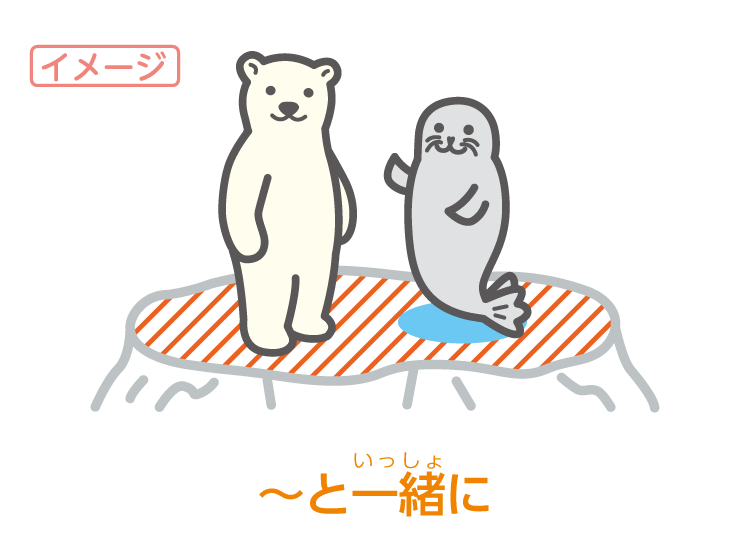
❶~といっしょに, ~とともに
with a dog
♔基本with a dog
犬と(いっしょに), 犬を連れて(いる)
⦣ with+名詞.
with him
with him
彼と(いっしょに)
⦣ with+目的格の代名詞. ×with he としない.
go with him
go with him
彼といっしょに行く
a boy with a dog
a boy with a dog
犬を連れている少年
I go to school with Ben and Joe.
I go to school with Ben and Joe.
私はベンやジョーといっしょに学校へ行く.
Jim was not with me yesterday.
Jim was not with me yesterday.
昨日はジムは私といっしょではなかった.
I'm sending you some pictures with this letter.
I'm sending you some pictures with this letter.
私はこの手紙とともに[に同封どうふうして]何枚かの写真をあなたに送ります.
I will bring my brother with me.
I will bring my brother with me.
私は弟を(私といっしょに)連れて行きます.
Take an umbrella with you.
Take an umbrella with you.
傘かさを持って行きなさい.
I have no money with me.
I have no money with me.
私は今お金を全然持ち合わせていない.
⦣ with me をつけないと「私は(ここにも家にも銀行にもどこにも)全くお金がありません[一文無しです]」の意味.
Are you with me?
Are you with me?
(説明の途中とちゅうで)(あなたは私といっしょにいますか)ここまではよろしいですか.
❷付属するものがいっしょに~を持っている, ~の付いた; ~を持ったままで
a girl with long hair
a girl with long hair
長い髪かみの毛の[ロングヘアの]女の子
a monster with a huge mouth
a monster with a huge mouth
巨大きょだいな口をした怪物かいぶつ
Do you know that big boy with a camera?
Do you know that big boy with a camera?
君はカメラを持ったあの大きな少年を知っていますか.
I'm Tom Brown with today's news.
I'm Tom Brown with today's news.
(私はきょうのニュースを持っている[伝える]トム・ブラウンです)皆みなさん, トム・ブラウンです. きょうのニュースをお伝えします.
She said goodbye with tears in her eyes.
She said goodbye with tears in her eyes.
彼女は目に涙なみだを浮うかべて別れを告げた.
❺相手といっしょに~と, ~に(対して), ~を相手に; ~に賛成して, ~とよく合って
talk with one's father
talk with one's father
父と話をする, 父に相談する
connect A with B
connect A with B
AとBをつなぐ
mix blue with red
mix blue with red
青と赤を混ぜる
I often fight with my brother.
I often fight with my brother.
私はよく兄[弟]とけんかをする.
I had a lot of fun with him.
I had a lot of fun with him.
私は彼といっしょでとてもおもしろかった[彼はとてもおもしろい人だった].
I agree with you.
I agree with you.
私は君に賛成だ.
Are you with me or against me?
Are you with me or against me?
君は僕ぼくに賛成なのか反対なのか.
❻時間的にいっしょに~とともに
rise with the lark
rise with the lark
ヒバリとともに起きる[早起きする]
With those words, he left.
With those words, he left.
彼はその言葉とともに[そう言って]去って行った.
With the coming of spring, the birds returned.
With the coming of spring, the birds returned.
春の訪おとずれとともに鳥たちも帰ってきた.
❼道具・材料~を使って(using), ~で; 原因・理由 ~のせいで
eat with (a) knife and fork
eat with (a) knife and fork
ナイフとフォークで食べる
study with a computer
study with a computer
コンピューターを使って勉強する
cut with a knife
cut with a knife
ナイフで切る
I took these pictures with this camera.
I took these pictures with this camera.
私はこのカメラでこれらの写真を撮とった.
He is eating his soup with a spoon, but his brother is eating without a spoon.
反対語He is eating his soup with a spoon, but his brother is eating without a spoon.
彼はスプーンでスープを飲んでいるが, 彼の弟はスプーンなしで[を使わないで]飲んでいる.
The streets were crowded with people.
The streets were crowded with people.
通りは人で混み合っていた.
He was in bed with a cold.
He was in bed with a cold.
彼は風邪かぜで寝ねていた.
That place became very dirty with trash and cans.
That place became very dirty with trash and cans.
その場所はごみや缶かんでとても汚きたなくなった.
❽~にとって(は), ~について, ~に関して
It's all right with me.
It's all right with me.
私についてはそれでけっこうです.
Something is wrong with this radio.
Something is wrong with this radio.
このラジオはどこかが故障している.
What's the matter with you?
What's the matter with you?
どうしたの(具合が悪そうだけど, 心配事でもあるの).
What's with you?
What's with you?
どうしたの(いつものあなたと違ちがうけど).
⦣ 前の文との違いに注意.
Anne helps me with my English homework.
Anne helps me with my English homework.
(アンが英語の宿題について私を助ける)アンが私の英語の宿題を手伝ってくれます.